
Probably not. And the data shows why.
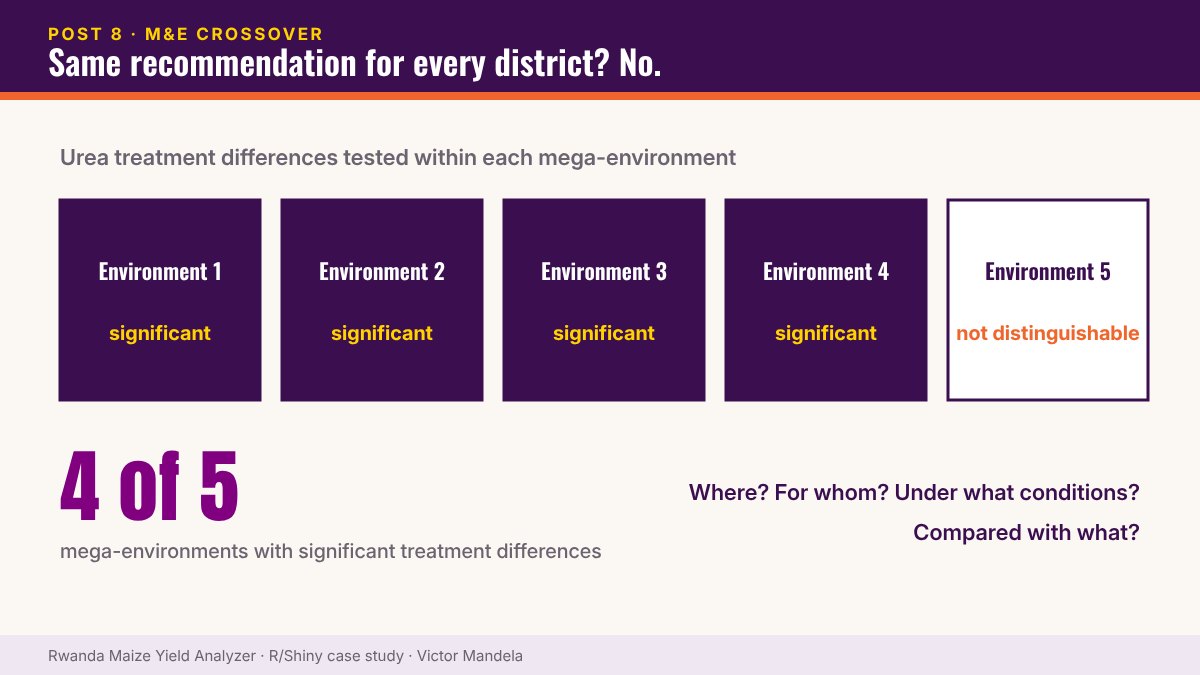
In the Rwanda maize analysis, urea performance was assessed across five mega-environments rather than assuming one treatment works identically everywhere. Statistical testing identified significant treatment differences in 4 of the 5.
In the Eastern Savannah, the split application strategy Urea 1 kg/Are (V6 + V10) reached the highest observed yield — 7.45 t/ha.
The fifth environment is just as informative
Where differences weren’t significant, the honest conclusion is that this evidence doesn’t distinguish between the strategies there — not that the national winner applies by default.
The same discipline applies to development programmes
An average treatment effect can hide a distribution wide enough to include zero for some groups. So the questions stay the same: Where? For whom? Under what conditions? Compared with what?
That’s how M&E and impact evaluation move beyond averages.
▶ Try it yourself — live R Shiny demo. Open the Rwanda Maize Yield Analyzer · Username: test · Password: test
Part 8 of 10 — The Maize Yield Case Study. Read the full case study and launch the dashboard › · Work with me on a similar project ›